Category: Comparisons & Fitment

  • What Fits in a Subaru Crosstrek?

    Disclosure: This article contains affiliate links. I may earn a commission at no extra cost to you.

    The Crosstrek is the smallest of the three Subaru models, and its cargo area doesn’t pretend otherwise — this is the honest version of that story, not a case for why it secretly holds as much as an Outback. What it actually offers is a genuinely capable everyday vehicle that fills up faster than the other two once real gear gets involved.

    That’s not a knock on it. For the right kind of load — daily errands, a single traveler, one dog, light weekend gear — the Crosstrek’s smaller footprint is barely a limitation. It only becomes one once you’re packing for a family, a long trip, or bulky one-off hauls.

    Quick Picks

    • Best for packing: Soft duffel bags — closer to mandatory than optional in a Crosstrek, since rigid luggage fights the narrow wheel wells much more than it does in the Outback or Forester.
    • Best for organization: Packing cubes — matters more here than in the bigger two models, since there’s less room to spread items out loose.
    • Best for reclaiming space: Hanging SUV storage net — a genuinely useful pick for the Crosstrek specifically, since vertical hanging storage recovers space the floor doesn’t have to give.
    • Best for flexible storage: Collapsible storage bins — flatten down completely when empty, which matters more in a cargo area this size.

    What Actually Affects Fitment in a Crosstrek

    The Crosstrek’s limitation isn’t shape the way it is with the Forester or Outback — it’s total volume. The cargo floor is shorter than the Outback’s and the cargo area is narrower at the wheel wells than the Forester’s, so rigid coolers and hard-sided bins lose more usable space here than they do in the other two models. Soft bags aren’t just the better choice in a Crosstrek, they’re close to necessary once you’re packing for more than a quick errand.

    What Fits for Everyday Use

    Groceries, a single cooler, and a compact stroller all fit without much thought. Where the Crosstrek starts to feel tight is the second bag, second passenger’s luggage, or a full-size double stroller — the kind of load that barely registers in an Outback fills the Crosstrek’s cargo area noticeably faster.

    Dog crates follow the same pattern: a small-to-medium crate fits cleanly, but a large crate often needs the front passenger seat pushed forward to clear, which isn’t the case in the Forester or Outback. See our Subaru Crosstrek Dog Setup guide for the honest breakdown on dog gear specifically.

    Large Items and One-Off Hauls

    • Bikes — fit with the seat down, but expect tighter maneuvering getting a full-size frame in and out than in either of the other two models.
    • Long lumber and flat-pack furniture — the Crosstrek’s weakest spot by a real margin. Anything long and flat needs roof transport far sooner than it would in an Outback.
    • Moving-day loads — realistic for a few boxes and light furniture; not a practical stand-in for a larger vehicle on an actual moving day.

    Crosstrek vs Outback vs Forester Cargo Space

    ModelBest StrengthBiggest LimitationBest For
    CrosstrekCompact and easy to manage dailyFills up fastest with passengers or gearLighter, simpler loads
    OutbackLong cargo floor and flexible packingLess vertical cargo height than ForesterFamily trips, camping, mixed daily use
    ForesterUpright cargo space and visibilityShorter cargo length than OutbackVertical loads, taller gear

    Common Mistakes

    • Assuming “compact SUV” styling means Outback- or Forester-level capacity. The Crosstrek is genuinely smaller, not just styled to look smaller.
    • Packing hard-sided bins or coolers first. Soft bags fit the narrow wheel wells far more efficiently — pack them first, not as an afterthought.
    • Waiting too long to consider roof storage. Of the three models, the Crosstrek is usually the first to actually need it.

    FAQs

    Is the Crosstrek big enough for a family?
    For a small family with light gear, yes. For a family regularly packing strollers, coolers, and luggage together, the Outback or Forester will feel noticeably less cramped.

    Can the Crosstrek fit a full-size stroller?
    Most full-size strollers fit, but they take up a larger share of the available space than they would in either of the other two models.

    What’s the biggest limitation of the Crosstrek’s cargo area?
    Total volume — it’s genuinely the smallest of the three, not just differently shaped.

    When do you actually need roof storage on a Crosstrek?
    Sooner than you would on an Outback or Forester — long gear, a second traveler’s luggage, or camping gear are common tipping points.

    Is the Crosstrek a bad choice for cargo-heavy use?
    Not a bad choice — a specific-purpose one. It’s excellent for daily use and light gear, and honestly not the right pick if cargo capacity is the priority.

    Final Thoughts

    The Crosstrek doesn’t compete with the Outback or Forester on cargo space, and it doesn’t need to — it’s a smaller vehicle built for a different priority. For daily use, one traveler, or light gear, it’s genuinely capable. For family-scale hauling or long trips with real gear, plan around its limits rather than against them.
    Related Guides

  • What Fits in a Subaru Forester?

    Disclosure: This article contains affiliate links. I may earn a commission at no extra cost to you.

    The Forester’s boxier shape changes what actually fits compared to the Outback — not necessarily more or less overall space, but a different shape entirely. Tall, upright items that fight for room under the Outback’s lower roofline fit the Forester without much thought, while long gear that needs to lie flat is where the Forester starts to feel tighter.

    Cargo shape and packing style usually matter more than the raw cargo number on a spec sheet — and that’s exactly where the Forester’s extra height and shorter floor length show up in real use.

    Quick Picks

    • Best for packing: Soft duffel bags — compress and fit around gear better than rigid luggage, especially in the Forester’s narrower wheel-well width.
    • Best for organization: Packing cubes — keep everyone’s stuff separated on longer trips.
    • Best for flexible storage: Collapsible storage bins — the Forester’s extra headroom means these can stack upright without hitting the cargo cover.
    • Best for the console: Forester center console organizer — solves everyday clutter that has nothing to do with the cargo area.

    What Actually Affects Fitment in a Forester

    The Forester’s real advantage is cargo height. Its boxier, more upright shape means bins, coolers, and tall items don’t get squeezed the way they can under a lower roofline — there’s genuinely more room to stack things vertically before hitting the cargo cover. The tradeoff is floor length: the Forester’s cargo floor is shorter than the Outback’s, so anything long and flat — skis out of a bag, long lumber, a fully reclined sleeping setup — is where the Forester loses ground first. Rear seat fold angle matters here too; a flatter fold helps offset the shorter floor somewhat, but it doesn’t fully close the gap.

    What Fits for Everyday Use

    Groceries, strollers, coolers, and weekend bags all fit comfortably — day-to-day use is where the Forester and Outback feel most similar. The real difference shows up with tall, upright items: a cooler that has to sit upright, a tall diaper bag, or stacked bins all fit more easily in the Forester because of the extra headroom, where they’d need to be laid flat in a lower-roofline vehicle.

    Dog crates are a good example of the Forester’s height paying off directly — a taller wire crate that would need to be angled or partially folded in a lower vehicle fits upright in the Forester without much thought. See our Subaru Forester Dog Setup guide for more on this specifically.

    Large Items and One-Off Hauls

    • Bikes — fit with the seat down; the extra headroom actually makes loading a full-size frame a little easier than in a lower vehicle, since there’s less need to remove the front wheel. A bike fork mount keeps interior transport clean.
    • Tall, upright items — potted plants, tall boxes, upright appliances — this is where the Forester’s height is a genuine, real advantage over the Outback.
    • Long lumber and flat-pack furniture — the Outback wins here. The Forester’s shorter floor means long, flat items hit the front seats sooner.
    • Moving-day loads — works fine for smaller moves and dorm-sized furniture; large flat items (mattresses, long dressers) are the Forester’s weakest spot.

    Forester vs Outback vs Crosstrek Cargo Space

    The Forester feels roomier vertically than either the Outback or Crosstrek, but its shorter cargo length shows up with long gear and family packing. The Outback usually feels biggest overall thanks to its longer floor. The Crosstrek works best with lighter, simpler loads and fills up fastest of the three.

    ModelBest StrengthBiggest LimitationBest For
    ForesterUpright cargo space and visibilityShorter cargo length than OutbackVertical loads, taller gear
    OutbackLong cargo floor and flexible packingLess vertical cargo height than ForesterFamily trips, camping, mixed daily use
    CrosstrekCompact and easy to manage dailyFills up fastest with passengers or gearLighter, simpler loads

    Common Mistakes

    • Assuming more headroom means more total space. The Forester’s height helps with upright items specifically — it doesn’t add length for flat, long gear.
    • Packing hard containers too early. Soft bags fit around the Forester’s narrower wheel wells more easily than rigid coolers or bins.
    • Forgetting the shorter floor when planning a sleeping setup. Sleeping flat takes more folding and adjustment than it does in an Outback.

    FAQs

    Does the Forester hold more than the Outback?
    Not usually in real use. The Forester offers better vertical space, while the Outback feels more flexible because of its longer cargo floor.

    Can the Forester fit a full-size stroller?
    Yes — most full-size strollers fit without issue, and the extra headroom makes loading them a little easier than in a lower-roofline vehicle.

    Is the Forester big enough for family road trips?
    Yes for most families — passenger visibility and headroom are genuine strengths, though longer gear needs more thought than it would in an Outback.

    What’s the biggest limitation of the Forester’s cargo area?
    Floor length. Long, flat items and full sleeping setups are where it loses ground to the Outback first.

    When do you actually need roof storage on a Forester?
    Usually once long gear (skis, lumber, a full camping load) stops fitting flat inside — the same point where any of the three models would need it, just reached a little sooner in the Forester than the Outback.

    Final Thoughts

    The Forester trades cargo length for cargo height compared to the Outback — a real, genuine tradeoff rather than a straightforward upgrade or downgrade. For upright, bulky items it’s the better fit of the two. For long, flat gear or sleeping setups, the Outback still wins. Knowing which one matters for your actual use is more useful than comparing raw cargo numbers.

    Related Guides

  • 1UP USA vs Kuat vs Thule Bike Racks

    Disclosure: This article contains affiliate links. I may earn a commission at no extra cost to you.

    When Subaru owners compare 1UP USA, Kuat, and Thule, the decision is usually about more than carrying bikes — durability, ease of use, bike protection, and long-term ownership often matter most. All three brands are highly capable premium platform racks; the best fit depends on how often the rack will be used, what bikes it needs to carry, and which features make everyday use easier.

    Quick Picks

    1UP USA vs Kuat vs Thule at a Glance

    Feature1UP USAKuatThule
    ConstructionAll AluminumAluminum/SteelAluminum/Steel
    ServiceabilityExcellentVery GoodVery Good
    Premium FeaturesModerateExcellentExcellent
    Rugged FeelExcellentVery GoodVery Good
    Overall FocusDurabilityFeaturesRefinement

    Design Philosophy

    1UP USA focuses on simplicity, durability, and serviceability — mostly aluminum construction with minimal plastic, feeling highly mechanical and purpose-built. Kuat combines strong construction with premium features and aesthetics: integrated work stands, smooth tilt mechanisms, and refined finishes designed to be enjoyable to use, not just functional. Thule prioritizes user experience, broad compatibility, and polished engineering, with intuitive controls that suit a wide range of bike styles. Of the three, 1UP USA often feels the most rugged thanks to its all-metal build and minimal plastic — Kuat and Thule are still excellent, just weighted more toward convenience and refined operation than raw ruggedness.

    Loading and Everyday Usability

    All three brands make loading standard road, gravel, and hybrid bikes straightforward — wheel-mounted retention systems avoid frame contact and take only seconds to secure. Differences show up more with modern mountain bikes (long wheelbases, large tires favor generous tray spacing) and with multiple bikes loaded at once, where handlebar interference and pedal clearance become more noticeable. In everyday use, convenience often comes down to small repeated tasks — folding the rack, tilting for hatch access, securing bikes — done far more often than most buyers expect. The best rack isn’t necessarily the one with the most features, but the one that makes those repeated tasks feel effortless.

    E-Bike Compatibility

    E-bikes often push the limits of lower-capacity racks, so verify both per-bike and total carrying capacity before buying, especially when carrying two e-bikes at once. Not every model within each brand’s lineup is built for heavier e-bikes — check the specific rack’s weight rating rather than assuming every premium rack handles them the same. Lifting a 50-70 lb e-bike gets old fast, which is where loading ramps earn their keep: they let you roll the bike into place instead of lifting it. 1UP USA is often favored for its high weight capacities, Kuat for user-friendly features, and Thule for broad compatibility — but the real factor is matching a specific model’s weight capacity and loading features to your bike, not brand alone.

    Rear Hatch Access

    A tilt mechanism pivots the rack away from the vehicle for hatch access — especially useful on Subarus where the cargo area regularly holds gear, groceries, strollers, or camping equipment, and one of the most-used features on a hitch rack in practice. All three brands offer tilt-capable premium racks, but operation differs: some designs favor simple mechanical durability, others smoother one-handed operation. Kuat is often praised specifically for how smooth and convenient its tilt operation feels day to day.

    Security, Protection, and Long-Term Ownership

    All three brands offer integrated locking for both rack and bikes — no lock stops theft entirely, but it deters opportunistic attempts, which matters for owners who stop at trailheads, restaurants, or hotels. Modern platform racks secure bikes by the wheels rather than clamping the frame, protecting carbon frames and painted finishes — part of why platform racks have become the standard for road, gravel, and mountain bikes. For long-term ownership, all three have strong durability reputations; the real differences show up in how a rack ages, how easy it is to service, and how readily replacement parts are available — 1UP USA’s rebuildable aluminum construction gives it an edge here specifically. Routine rinsing and periodic lubrication of pivots and locks keeps any of the three running smoothly for years, which matters most for owners who drive year-round through weather and road salt.

    Family Use and Multiple Bikes

    Two-bike setups cover most everyday riding — lighter, simpler to store, and enough for couples or a solo rider with an occasional passenger. Family trips carrying three or four bikes put more weight on rack capacity, tray spacing, and hitch stress, and a rack that felt roomy with two bikes can feel crowded fully loaded. Mixing adult and kids’ bikes on the same rack adds another wrinkle — tray-style racks generally adapt to mixed wheel sizes better than hanging designs. Kuat and Thule are the more popular family picks thanks to their convenience features and easy hatch access; see our full Best Hitch Bike Rack for Families guide for more on sizing a rack to your family.

    Crosstrek vs Forester vs Outback

    The Crosstrek’s smaller size makes a hitch rack especially valuable since it adds capacity without eating interior cargo space, and its lower stance keeps loading straightforward. The Forester’s taller roof makes a hitch rack more appealing than roof-mounted carriers — loading at hitch height means less lifting, which owners with e-bikes or family bikes especially appreciate. The Outback’s longer body and road-trip focus pair well with any premium platform rack, with rear hatch access becoming the main consideration given its already-generous cargo space. All three work well with all three brands — vehicle choice matters less here than bike type and how often you’re loading.

    Which Buyer Fits Each Brand?

    If You Prioritize…Best Fit
    Maximum Durability1UP USA
    Premium FeaturesKuat
    Ease of UseThule
    E-BikesDepends on model
    Family UseKuat / Thule
    Long-Term Ownership1UP USA
    Broad CompatibilityThule

    Common Mistakes

    • Buying based only on price. Durability, stability, and ease of loading usually matter more than the sticker price for a rack you’ll use every week.
    • Ignoring bike weight. Not every rack shares the same weight limits — verify per-bike capacity before buying, especially for e-bikes or downhill bikes.
    • Overlooking hatch access. Cargo access becomes an everyday need on road trips and grocery runs — a good tilt mechanism makes a real difference.
    • Buying more capacity than needed. A four-bike rack adds weight, cost, and size — size to your typical trips, not the occasional one.
    • Focusing on features you’ll never use. Premium finishes and extras matter less than everyday usability for how you actually ride.

    FAQs

    Is 1UP USA better than Kuat?

    It depends — 1UP USA is favored for durability, while Kuat emphasizes convenience and refined features.

    Which bike rack is best for e-bikes?

    All three offer e-bike-capable models — focus on weight capacity and loading ease rather than brand alone.

    Which rack is easiest to load?

    Kuat racks are often considered the easiest thanks to user-friendly controls and loading features.

    Which rack lasts the longest?

    1UP USA has a strong reputation for long-term durability and rebuildable aluminum construction.

    Which rack offers the best hatch access?

    All three offer tilt mechanisms, but Kuat is often praised for the smoothest, most convenient operation.

    Are premium bike racks worth the extra cost?

    For frequent riders, families, and e-bike owners, the added durability, stability, and convenience are usually worth it.

    Which rack works best on a Subaru Forester or Outback?

    All three work well on either model — the better question is which bike type and usage pattern you have, not which vehicle.

    Final Thoughts

    All three brands offer excellent options for Crosstrek, Forester, and Outback owners, but they prioritize different strengths — some riders value maximum durability, others convenience, hatch access, or e-bike support. The best choice depends on how many bikes you carry, how often you ride, and which features matter most day to day. Choosing based on your typical riding habits, not occasional situations, leads to the best long-term experience.

    Related Guides

    Best Bike Rack for Subaru Crosstrek

    Best Bike Rack for Subaru Forester

    Best Bike Rack for Subaru Outback

    Best Hitch Bike Rack for Families

    Hitch Rack vs Roof Rack for Bikes

  • J-Cradle vs Saddle Kayak Carriers

    Disclosure: This article contains affiliate links. I may earn a commission at no extra cost to you.

    Many Crosstrek, Forester, and Outback owners eventually choose between J-cradles and saddle carriers when setting up a kayak-hauling system. Both work well, but they prioritize different things: J-cradles maximize roof space and make carrying two kayaks easier, while saddles are simpler to load and provide excellent support, especially for heavier kayaks. The right choice comes down to how many kayaks you carry, how easy loading needs to be, and how you typically use your roof.

    J-Cradle vs Saddle at a Glance

    FactorJ-CradleSaddle
    Kayak TransportExcellentGood
    Loading EffortModerateEasier
    Kayak SupportGoodExcellent
    Heavy KayaksModerateBetter
    Additional Roof GearEasierMore Limited
    Best ForMultiple kayaks, maximizing roof spaceSingle kayaks, easier loading
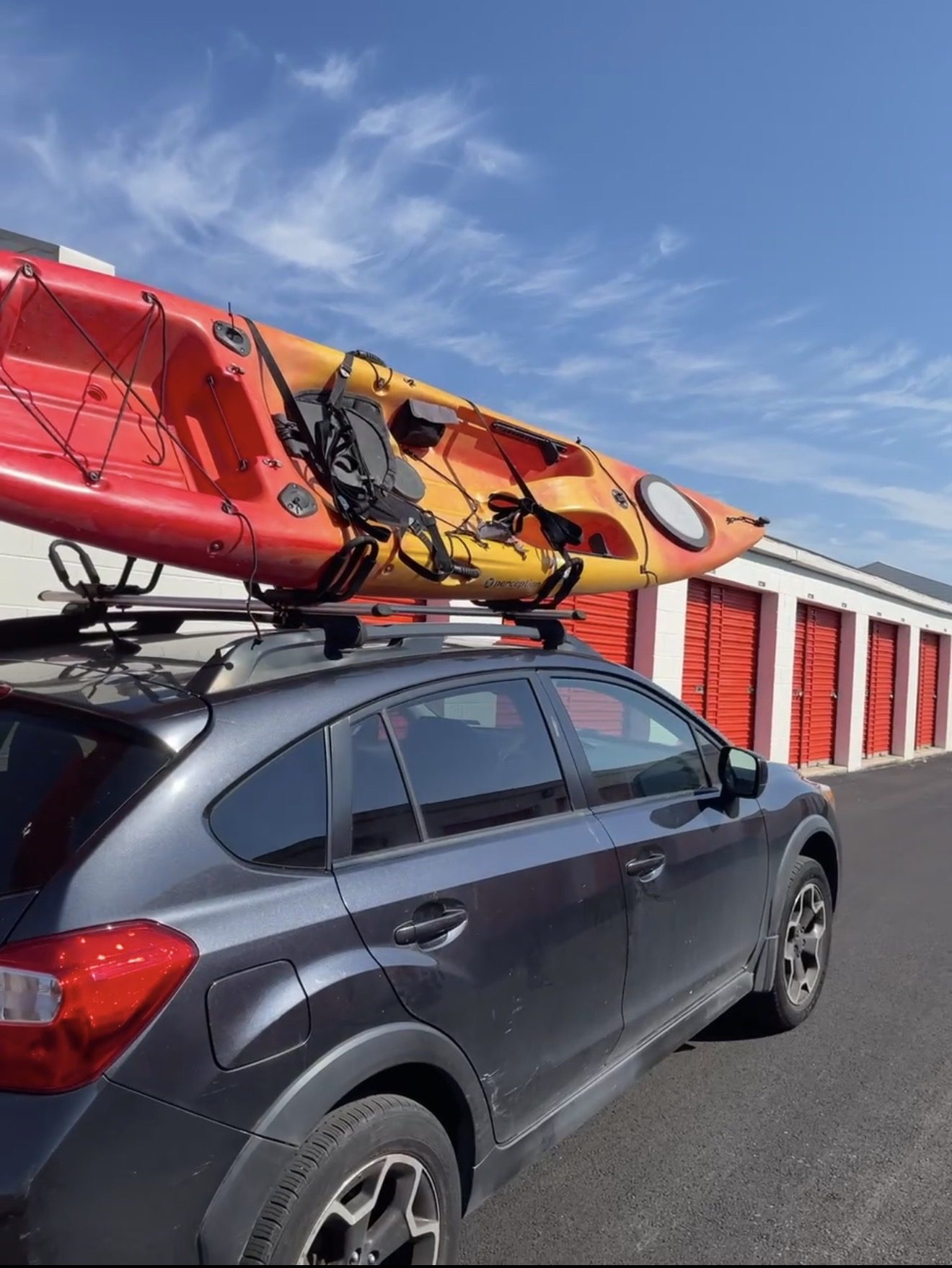
    Kayak mounted on a Subaru Crosstrek roof rack
    A kayak mounted on a Subaru Crosstrek’s roof rack.

    How Each Style Works

    J-cradles hold a kayak on its side at an angle rather than flat against the crossbars, using straps that wrap around both the carrier and the kayak. This upright position uses roof width efficiently, leaving more room for a second kayak or other gear — especially valuable on a Crosstrek, where roof space is tighter than on a Forester or Outback. The tradeoff: positioning the kayak on its side adds an extra step when loading, and it increases the kayak’s height on the roof.

    Saddles support the hull from below with the kayak resting flat, which most owners find easier to load solo — the kayak can be lifted straight up and centered without rotating it. Saddles also provide more continuous hull support across multiple contact points, which matters more for longer touring kayaks. The tradeoff: saddles use more roof width per kayak, so fitting two becomes tighter sooner than with J-cradles.

    Loading Effort by Model

    The Crosstrek’s lower roof height makes loading easier regardless of carrier style, so the usual saddle advantage matters less here. The Forester’s taller roof makes the difference more noticeable — reaching across the roof to rotate a kayak into a J-cradle takes more lifting, so many owners find saddles easier to work with, especially for heavier kayaks. The Outback sits lower than the Forester while offering one of the longest roofs in the lineup, giving it enough flexibility to work equally well with either style.

    One Kayak vs Two Kayaks

    A single kayak works well with either style. The difference shows up once a second kayak enters the picture — J-cradles use roof width more efficiently, which is why couples and families who regularly paddle together tend to prefer them, while saddles can still work for two boats but hit the roof-width limit sooner. For a single kayak, saddles usually offer the simplest, most user-friendly setup; for two, J-cradles usually offer more flexibility.

    Wind Noise and Fuel Economy

    J-cradles typically create more aerodynamic drag and wind noise since the kayak rides upright and presents more surface area to the airflow — noticeable mainly at highway speed. The added height can also matter for garage or parking-deck clearance. Saddles keep the kayak lower and flatter against the roof, which usually means less turbulence and a smaller height increase.

    Common Mistakes

    • Choosing based on price alone. Loading convenience and roof-space efficiency usually matter more for everyday use than the sticker price.
    • Ignoring kayak weight. Recreational, fishing, and touring kayaks vary a lot in weight — consider how much you’ll actually be lifting, and whether you usually load alone.
    • Underestimating loading effort. A setup that seems manageable once can get frustrating fast if you’re using it every weekend.
    • Forgetting about roof height. A carrier that works fine on a Crosstrek can feel very different on a Forester.
    • Buying more carrier than you need. Match the carrier to your typical trips rather than paying for capacity you rarely use.

    FAQs

    Are J-cradles better than saddle carriers?

    It depends on your priorities — J-cradles maximize roof space for multiple kayaks, while saddles are easier to load and support the hull better.

    Which carrier is better for a Forester?

    Many owners prefer saddles on a Forester since the kayak stays flat and doesn’t need to be rotated across the taller roof.

    Which carrier is better for an Outback?

    Either works well — the Outback’s long roof and lower loading height make it flexible enough for both styles.

    Can I carry two kayaks with saddle carriers?

    Yes, but roof width becomes a limiting factor sooner than with J-cradles.

    Do J-cradles create more wind noise?

    Usually yes, since the kayak rides upright and presents more surface area to the airflow.

    Which carrier is best for most Subaru owners?

    For a single kayak, most owners prefer saddles. For two kayaks or maximizing roof space, J-cradles are usually the better choice.

    Final Thoughts

    For most Crosstrek, Forester, and Outback owners, the choice comes down to roof space versus loading convenience. The Yakima JayLow Kayak Carrier is a strong J-cradle pick for owners hauling two kayaks or maximizing roof space; the MALONE Saddle Up Pro Kayak Carrier is the easier-loading saddle option for a single kayak. If your roof needs also extend beyond kayaks, a Thule Motion 3 Roof Box is worth a look for overflow storage.

    Related Guides

    Best Crossbars for Subaru Outback

    Factory vs Aftermarket Crossbars for Subaru

    Best Cargo Box for Subaru

    Subaru Roof Rack Weight Limits Explained

    Cargo Box vs Cargo Basket on a Subaru Outback

  • Hitch Cargo Carrier vs Roof Box

    Disclosure: This article contains affiliate links. I may earn a commission at no extra cost to you.

    Many Subaru owners eventually need more cargo space for road trips, camping gear, family travel, or outdoor equipment. Hitch cargo carriers and roof boxes are the two most common solutions — both add storage outside the vehicle, but they serve different purposes. Hitch carriers prioritize easy loading and bulky gear, while roof boxes provide enclosed, weather-protected storage. For Crosstrek, Forester, and Outback owners, the best choice depends on the type of cargo you carry, how often you use it, and which setup is easier to live with day to day.

    Quick Picks

    Hitch Cargo Carrier vs Roof Box at a Glance

    CategoryHitch Cargo CarrierRoof Box
    Loading EaseExcellentModerate
    Weather ProtectionMinimalExcellent
    Heavy GearExcellentGood
    Luggage StorageGoodExcellent
    Fuel Economy ImpactLowerModerate
    Rear Hatch AccessMay Be LimitedExcellent
    Vehicle Height ImpactNoneIncreases Height
    SecurityModerateBetter
    Best ForCamping gear, coolers, bulky cargoLuggage, road trips, protected storage

    How Each Works

    A hitch cargo carrier slides into the receiver hitch and locks in place with a hitch pin — most Subarus use 2-inch receivers, though smaller carriers exist for 1.25-inch hitches. Most use an open platform design with raised rails; cargo sits on top secured by straps or cargo nets, which works well for durable gear like coolers, storage bins, camping equipment, firewood, and folding chairs, but leaves everything exposed unless you add weather-resistant covers. The biggest advantage is loading convenience — heavy items go on without lifting them overhead, and dirty or wet gear stays outside the cabin entirely.

    A roof box attaches directly to the crossbars and becomes a fixed part of the roof system until removed — compatible with most factory and aftermarket crossbars. Unlike open carriers, it’s fully enclosed, protecting gear from rain, snow, road grime, and sun, and most models include locking lids for extra security. Roof boxes are the better fit for luggage, duffel bags, sleeping bags, and other items that benefit from weather protection — popular for family vacations, ski trips, and road trips where you need storage without sacrificing passenger comfort.

    Loading and Cargo Capacity

    For most owners, a hitch cargo carrier is easier to load and unload — the lower height simplifies handling bulky or heavy cargo and cuts down on physical effort. Roof boxes win on weather protection and organization, but when loading convenience is the priority, most owners find a hitch carrier more user-friendly day to day.

    Cargo TypeHitch Cargo CarrierRoof Box
    CoolersExcellentGood
    LuggageGoodExcellent
    Camping GearExcellentGood
    Sports EquipmentGoodExcellent
    Dirty GearExcellentFair
    Oversized ItemsExcellentLimited

    Weather Protection and Security

    A roof box provides the highest level of weather protection — gear stays enclosed and shielded from rain, snow, road salt, and dust for the whole trip, and locking lids keep cargo out of sight and less attractive to opportunistic theft. Most hitch carriers leave cargo exposed unless you add waterproof cargo bags, bins, or hard-sided containers — workable, but it requires more planning than just closing a lid, and exposed cargo needs more attention when parked. A locking hitch pin is a cheap, worthwhile upgrade if you’re running an open carrier. For long road trips specifically, weather protection and security tend to matter more than raw capacity, which is part of why many owners lean toward roof boxes for cross-country travel.

    Fuel Economy and Wind Noise

    Roof boxes sit directly in the airflow above the vehicle and increase aerodynamic drag — modern designs reduce turbulence, but expect some fuel economy hit compared to driving without one. Hitch carriers ride behind the vehicle where airflow is already disrupted, so they generally create less drag, though bulky or poorly packed loads can still cost you some efficiency on the highway. The gap is most noticeable at interstate speeds, where roof boxes generate more wind noise from direct airflow exposure while hitch carriers stay quieter riding low and behind the vehicle.

    Rear Hatch Access

    A hitch carrier occupies the space directly behind the vehicle, so rear hatch access may be limited or fully blocked depending on the carrier and what’s loaded — noticeable on road trips when you need frequent access to coolers or backpacks. Fold-up designs let the platform stand vertically when empty, and premium models that tilt or swing away improve hatch access further, at added cost and complexity. A roof box doesn’t touch the rear hatch at all, giving full cargo access at every stop — a real advantage for family trips with frequent stops.

    Crosstrek vs Forester vs Outback

    The Crosstrek’s cargo space is useful for daily driving but reaches its limits sooner than a Forester or Outback on family trips and longer vacations — owners frequently benefit from adding either option once interior storage runs out. The Forester balances passenger comfort and cargo capacity well, and its taller cargo area holds a surprising amount, but longer trips can still push it to the limit, which is why many Forester owners add exterior storage to keep the cabin less crowded. The Outback combines generous cargo space with a long roof that works particularly well for road trips, giving it strong compatibility with either a roof box or hitch carrier depending on what you’re hauling.

    Common Mistakes

    • Ignoring tongue weight limits. The combined weight of carrier and cargo counts against the hitch rating — verify vehicle, hitch, and carrier limits before loading.
    • Exceeding roof load limits. Box weight, crossbars, and cargo all count toward the roof rating — the lowest-rated component sets the real ceiling.
    • Choosing more capacity than needed. Oversized boxes and carriers add weight, cost, and storage hassle most owners never fully use.
    • Forgetting about vehicle length. A hitch carrier extends past the rear bumper and affects parking, backing up, and tight maneuvering.
    • Forgetting about vehicle height. Roof boxes add clearance concerns for garages, parking decks, and drive-throughs — easy to remember while loading, easy to forget later.

    What Actually Works

    Families often prefer roof boxes because they keep luggage and travel gear protected from weather while preserving full rear hatch access. Campers tend to prefer hitch carriers because bulky items — coolers, firewood, camp kitchens — don’t fit neatly in a roof box, and the lower loading height helps when handling heavy gear repeatedly through a trip. Dirty or wet equipment tips the decision toward a hitch carrier for most owners, since it keeps mess out of an enclosed space shared with luggage. Some owners who travel frequently for different activities end up using both rather than replacing one with the other — a roof box for vacations and luggage, a hitch carrier for camping and dirty gear. When in doubt, convenience usually wins: the setup that’s easiest to load and live with gets used more than the one with the most capacity on paper.

    FAQs

    Is a hitch cargo carrier better than a roof box?

    It depends — hitch carriers are easier to load, while roof boxes provide better weather protection and security.

    Does a roof box hurt fuel economy more?

    Usually yes — roof boxes sit directly in the airflow and typically create more drag than hitch carriers.

    Can I open the rear hatch with a hitch cargo carrier installed?

    Sometimes — it depends on the carrier design and whether it includes a tilt-away or swing-away feature.

    Which option is better for camping gear?

    Hitch cargo carriers, usually — better for bulky equipment, coolers, firewood, and storage bins.

    Are hitch cargo carriers waterproof?

    No — most are open platforms and need waterproof bags or containers to protect cargo.

    Is a roof box more secure?

    Generally yes — most roof boxes include locking lids and keep cargo out of sight.

    Can I use both a roof box and a hitch cargo carrier at the same time?

    Yes — many owners use both when they need maximum cargo capacity for vacations or camping trips.

    Final Thoughts

    The choice between a hitch cargo carrier and a roof box depends on the gear you carry and how you use your Subaru. Hitch carriers are usually easier to load and better for bulky or dirty gear; roof boxes provide better weather protection, security, and organization for luggage and travel equipment. For most Crosstrek, Forester, and Outback owners, the best option is the one that fits their typical trips, not the one with the most features.

    Related Guides

    Cargo Box vs Cargo Basket on a Subaru Outback

    Best Cargo Box for Subaru Outback

    Subaru Factory Roof Rails vs Aftermarket Crossbars

    Subaru Outback Car Camping Setup

    Subaru Road Trip Setup (Family + Space)

    Subaru Grocery Hauling Setup

    What Size Cargo Box Fits a Crosstrek?

  • Hitch Rack vs Roof Rack for Bikes

    Disclosure: This article contains affiliate links. I may earn a commission at no extra cost to you.

    Transporting bikes is something most Crosstrek, Forester, and Outback owners eventually need to solve. Both hitch racks and roof racks work well, but the right choice usually comes down to loading effort, bike weight, and how often you actually use the rack — not raw capacity.

    Hitch Rack vs Roof Rack at a Glance

    FactorHitch RackRoof Rack
    Loading HeightLowHigh
    Lifting EffortLowModerate-High
    E-Bike FriendlyExcellentLimited
    Rear Hatch AccessDepends on designUnaffected
    Wind Noise / MPG ImpactLowerHigher
    Keeps Hitch FreeNoYes

    Why Owners Choose a Hitch Rack

    Hitch racks keep bikes low to the ground, so loading doesn’t mean lifting overhead — a real advantage with heavier bikes, e-bikes, or family setups with multiple kids’ bikes. Many also tilt or swing away for rear hatch access, and the lower loading height means less wind noise and a smaller fuel economy hit than roof-mounted bikes. For frequent riders, this is usually the setup that actually gets used trip after trip.

    Why Owners Choose a Roof Rack

    A roof rack keeps the hitch receiver free for towing or a cargo carrier, and it leaves the rear hatch completely unobstructed regardless of what’s loaded. The Crosstrek’s lower roof height makes this the easiest of the three models to load onto, so owners with one or two lighter bikes often find it a practical, low-cost option — especially if they already run crossbars for skis or a cargo box.

    Heavy Bikes and E-Bikes Change the Math

    The gap between the two styles widens fast as bike weight increases. Mountain bikes, fat-tire bikes, and especially e-bikes get genuinely difficult to lift onto a roof — a fully loaded e-bike can be 50+ lbs, and doing that overhead alone isn’t realistic for most people. This is the single biggest reason hitch racks dominate for heavier bikes: an e-bike hitch rack is built specifically to handle that weight at a low loading height, and always verify the rack’s tongue weight rating against your bikes’ combined weight before loading.

    Rear Hatch Access and Garage Clearance

    Hatch access depends entirely on the hitch rack’s design — some tilt or swing away for full access, others block it while bikes are loaded, so check this before buying if you regularly need the cargo area. Roof racks avoid the issue entirely, but they trade it for a different one: added vehicle height. Loaded bikes can push a Crosstrek, Forester, or Outback past garage door clearance, low parking decks, or drive-through canopies. Forgetting the bikes are up there is one of the most common (and costly) roof rack mistakes — get in the habit of double-checking clearance before pulling into anything low.

    Subaru Model Differences

    All three models work with either rack style, but roof height and tow rating shift which one makes more sense.

    ModelRoof HeightRoof Rack FitHitch Rack Fit
    CrosstrekLowestBest — easiest solo loadingExcellent
    ForesterTallestWorkable, but more reach neededExcellent — usually the better default
    OutbackLong, moderate heightGoodExcellent — best for heavy hitch loads and e-bikes

    The Crosstrek’s low roof makes it the most roof-rack-friendly of the three. The Forester’s height pushes most owners toward a hitch-mounted rack instead. The Outback sits in the middle and handles either style well, with enough tow capacity to make it the strongest choice for e-bikes.

    Common Mistakes

    • Buying more capacity than needed. A 4-bike rack is heavier, pricier, and harder to maneuver than a 2-bike rack most owners with one or two bikes will never fully use.
    • Ignoring weight limits. Check both the rack’s tongue weight rating and the combined weight of your bikes — this matters most with mountain bikes and e-bikes.
    • Forgetting about garage clearance. Roof-mounted bikes add real height. Measure before you assume a garage or parking deck still clears.
    • Choosing based on capacity instead of how the rack actually gets used. A rack that’s quick to load and easy to live with day to day beats one sized for a rare best-case trip.

    FAQs

    Are hitch racks better than roof racks?

    It depends on your priorities. Hitch racks are easier to load and better for heavy bikes; roof racks keep the hitch free and don’t affect hatch access.

    Which style works best for e-bikes?

    Hitch racks, by a wide margin. E-bike weight makes overhead loading impractical for most people.

    Do roof racks increase wind noise and hurt gas mileage?

    Yes, more than hitch racks. Bikes on the roof sit directly in the airflow, which adds drag and noise, especially at highway speed.

    Can you still open the hatch with a hitch rack installed?

    Often yes — many hitch racks tilt or swing away for hatch access. Check this feature specifically if you use your cargo area often.

    Does one Subaru model favor a particular rack style?

    The Crosstrek is the most roof-rack-friendly thanks to its low roof. The taller Forester usually favors a hitch rack instead. The Outback works well with either.

    Final Thoughts

    Both styles work well across the Crosstrek, Forester, and Outback lineup — the right pick comes down to bike weight, how often you ride, and whether you need the hitch free for towing. A hitch-mounted platform rack is the more convenient default for most owners; a roof-mounted rack makes more sense if you’re already running roof accessories or need the hitch open.

    Related Guides

    Best Bike Rack for Subaru Crosstrek

    Best Hitch Cargo Carrier for Subaru

    Best Kayak Carrier for Subaru Crosstrek

    Best Ski Rack For Subaru Crosstrek

    Do Aftermarket Crossbars Increase Wind Noise on a Subaru

    Cargo Box Height Garage Clearance Guide